Brain Loves Stories: Memory Hacks for Sri Lankan Students

Stories, emotions, place, and time are not just "nice to have" for learning, they are core features of how the human memory system works.[1][2] When students turn dry facts into vivid, personal narratives, recall can jump from almost nothing to nearly everything remembered.[1]
How Memory Actually Works
Memory is not a filing cabinet. Modern cognitive science shows that memories are stored as networks of associations, people, places, emotions, and storylines all linked together.[2][5] When you try to recall a fact, your brain searches this network. The richer the connections, the easier the recall.
Narrative and emotional context are especially powerful because they give the brain many different "hooks", who was there, what happened first, where it was, and how it felt.[2][8] A bare list of items gives almost no hooks, so it's quickly forgotten once you stop rehearsing it.
The Vox–Netflix documentary The Mind, Explained captures this well in its memory episode.[3] It shows that people best remember moments tied to:
- Place : where it happened
- Time : the order of events
- Emotion : how it felt: exciting, scary, funny, sad
These are exactly the ingredients you can add to boring study material, formulas, definitions, lists, to make them stick like scenes in a film.[3]
The Classic Experiment: 93% vs 13%
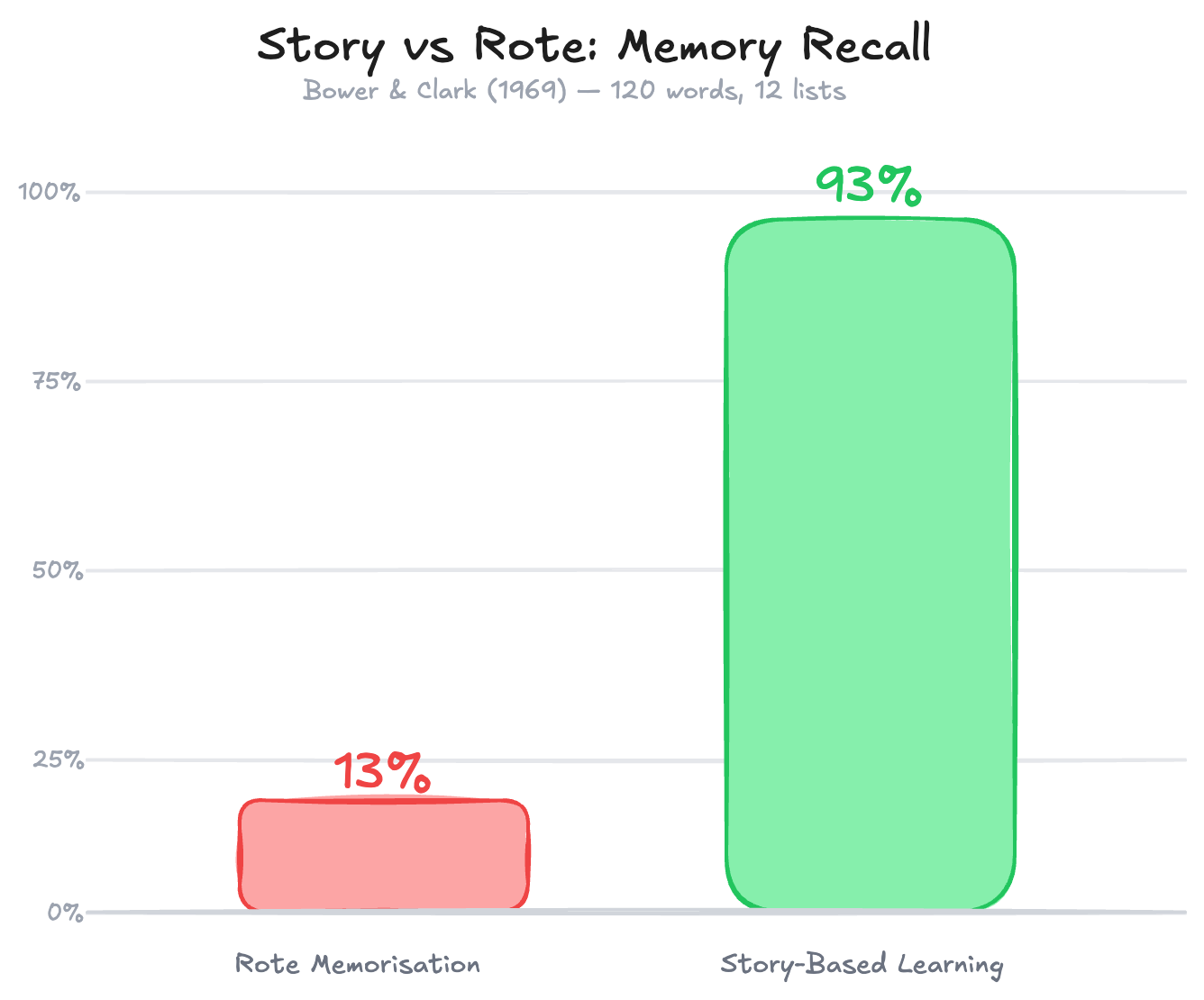 Recall rate comparison between narrative and control groups
In 1969, Gordon Bower and Michal Clark asked participants to learn twelve lists of ten nouns each, 120 words total.[1]
Two groups, same study time:
- Control group: Studied and rehearsed the words as normal lists
- Narrative group: Created a meaningful story chaining the ten words together in order, like a mini movie[1]
Immediately after each list, both groups recalled almost perfectly. Short-term memory was fine for everyone.[1]
Then came the real test: after all twelve lists, recall was tested again.
- Control group: ~13% recalled
- Narrative group: ~93% recalled[1]
Six to seven times more. Same time spent studying. Just a different way of organising the information.
This is one of the clearest demonstrations in memory research that thematic, story-based organisation massively boosts recall, especially when you're dealing with large amounts of information that would normally interfere with each other.[1][4]
Why This Happens
Your brain literally synchronises around stories
Here's something that doesn't get talked about enough. Researchers studied brain activity in people watching the same TV show or listening to the same audio story, separately, with no contact between them.[7][9] At the emotional, suspenseful, and surprising moments, their neural activity synchronised with each other.[7]
And the synchronisation predicted memory. The stronger the neural coupling at a given moment, the better people later recalled what happened at that moment.[7][9]
What this means practically: a well-constructed story doesn't just help you pay attention, it locks your attention onto the right moments automatically.[7][10] Your brain is doing the highlighting for you.
Emotion tells your brain what's worth keeping
When something feels emotionally significant, the amygdala (the brain's emotion-processing region) sends a signal to the hippocampus, the region responsible for forming long-term memories, essentially flagging the moment as worth keeping.[8]
Multiple experiments confirm that neutral items remembered in an emotional context are retained significantly better than the same items in a neutral context.[11] The emotional charge isn't decorative, it's a biological priority signal.[8][11]
For exam prep, even a small twist, something funny, embarrassing, surprising, or personally relevant, can act as that signal. Your brain doesn't need a dramatic scene. It just needs something worth caring about.[8]
Place and time give memory a return address
Context models of memory argue that items are stored alongside a "context state", essentially a snapshot of where and when they were learned.[5][6] When something later reminds you of that context, it helps retrieve the entire cluster of associated items, not just the one you were looking for.[6]
That's why anchoring a concept to a specific scene: "I was imagining this chemistry reaction happening next to the Milo machine in the school canteen", can pull the whole concept back when you're sitting in an exam hall. The canteen becomes a retrieval cue that unlocks everything stored alongside it.[5][6]
Turning Sri Lankan Exam Content Into Stories
Where students get stuck
Sri Lankan students preparing for O/L and A/L often struggle with:
- Long lists of definitions and classifications in Biology, Geography, Commerce, and History
- Multi-step processes (cellular respiration, accounting cycles, economic policies) that must be recalled in order
- Abstract formulas in Maths and Physics with symbols but no "human" meaning
Most students handle this by rereading, underlining, and repeating, essentially what the control group in Bower and Clark's experiment did.[1] The science tells us exactly why so much gets forgotten after a few days or weeks.[1][4]
Story approaches by subject
Biology (e.g. blood circulation): Turn the path of blood through the heart and body into a journey: a red blood cell "student" travelling from the village (body tissues) to Colombo (heart), passing checkpoints (valves) and security checks (lungs) along the way.
Economics (e.g. inflation causes): Imagine Sri Lanka as a small island shop. Each cause of inflation becomes a different type of customer or decision: the government printing money is a hyperactive shop owner, import shortages are delayed suppliers stuck at the harbour.
History: Already narrative by nature. Focus on sequence: where a leader starts, what obstacles appear, turning points, and the emotional stakes for ordinary people.
ICT or Physics definitions: Group five to ten definitions into a single scene: a class in the school computer lab where each student represents a concept (RAM, ROM, CPU) and they interact in a short skit.
These aren't childish tricks. They're efficient hacks grounded in decades of memory research.[1][2][4]
The PLACE Story Method
A repeatable framework for turning any study content into a story:
- P, Place: Choose a familiar Sri Lankan location: your classroom, bus route, tuition class, Kandy Lake, Galle Fort, Jaffna library
- L, Line of events: Decide the order: where does the story start, what happens second, third, matching the sequence of syllabus points
- A, Actors: Turn each key point, formula, or definition into a person or object that can move and speak
- C, Conflict or emotion: Add a small problem, joke, or emotional twist, something embarrassing, funny, surprising, or slightly dramatic
- E, Ending: Finish with a simple outcome that connects back to the exam concept (e.g. "That's how demand increases price")
This mirrors the narrative-chaining technique from Bower and Clark's experiment, just localised for Sri Lankan contexts and exam content.[1][4][6]
The Compounding Effect: Stories + Testing
Here's where it gets interesting. Stories on their own are powerful. But pairing them with retrieval practice, actually testing yourself, not just rereading, creates a compounding effect.
Research shows that the act of retrieving a memory strengthens it more than re-studying the same material.[12][13] Every time you pull something out of memory, the pathway becomes more accessible the next time.[12] The story gets you to the answer the first time. The testing locks it in for the tenth time.[13]
In other words: build the story, then quiz yourself on it. The two are not interchangeable, they each do something the other can't.[12][13]
A Simple Study Routine
Whenever you sit down to study:
- Identify lists and processes: if your notes have more than five bullets, steps, or definitions, mark them as "story material" instead of trying to memorise them as raw lists
- Apply the PLACE Story Method: choose a familiar place, set a sequence, turn points into characters, add a bit of emotion, and build a short scene in your head
- Test yourself immediately after: do three to five MCQs or short questions from past papers to check whether the story actually helps recall[12][13]
Stories make it easier to remember during quizzes. Quizzes then strengthen the underlying memory traces. Over time, the two work together.[12][13]
Key Takeaways
- The brain is wired to remember stories with emotion, place, and time far better than disconnected facts.[2][3][7]
- Turning lists into narratives boosted long-term recall from ~13% to ~93% in controlled experiments, a six to seven times improvement.[1]
- Stories work because they synchronise attention, trigger emotional memory tagging, and provide contextual retrieval cues that plain lists simply don't have.[7][8][10][11]
- The biggest compounding effect comes from pairing story-based encoding with active retrieval practice, not using one or the other.[12][13]
- Sri Lankan O/L and A/L content is full of lists and processes that can be transformed into stories using simple frameworks like PLACE.[1][4][6]
References
[1] G. H. Bower and M. C. Clark, "Narrative stories as mediators for serial learning," Psychonomic Science, vol. 14, no. 4, pp. 181–182, 1969.
[2] J. Bruner, Acts of Meaning. Cambridge, MA: Harvard University Press, 1990.
[3] The Mind, Explained, "Memory" episode, Netflix/Vox Media, 2019.
[4] G. H. Bower, "Analysis of a mnemonic device," American Scientist, vol. 58, no. 5, pp. 496–510, 1970.
[5] E. Tulving, Elements of Episodic Memory. Oxford: Oxford University Press, 1983.
[6] M. W. Howard and M. J. Kahana, "A distributed representation of temporal context," Journal of Mathematical Psychology, vol. 46, no. 3, pp. 269–299, 2002.
[7] U. Hasson et al., "Neurocinematics: The neuroscience of film," Projections, vol. 2, no. 1, pp. 1–26, 2008.
[8] J. LeDoux, The Emotional Brain. New York: Simon & Schuster, 1996.
[9] L. J. Silbert et al., "Coupled neural systems underlie the production and comprehension of naturalistic narrative speech," Proceedings of the National Academy of Sciences, vol. 111, no. 43, pp. E4687–E4696, 2014.
[10] M. M. Chun and N. B. Turk-Browne, "Interactions between attention and memory," Current Opinion in Neurobiology, vol. 17, no. 2, pp. 177–184, 2007.
[11] L. Cahill and J. L. McGaugh, "A novel demonstration of enhanced memory associated with emotional arousal," Consciousness and Cognition, vol. 4, no. 4, pp. 410–421, 1995.
[12] J. D. Karpicke and J. R. Blunt, "Retrieval practice produces more learning than elaborative studying with concept mapping," Science, vol. 331, no. 6018, pp. 772–775, 2011.
[13] H. L. Roediger and A. C. Butler, "The critical role of retrieval practice in long-term retention," Trends in Cognitive Sciences, vol. 15, no. 1, pp. 20–28, 2011.
Ready to experience BrainUs AI?
Join thousands of Sri Lankan students who are already learning smarter with AI-powered education.